When it comes to engine performance, people often talk about boost levels, compression ratios, or turbo size. But there’s one factor that quietly determines whether your build lasts a few laps or thousands of miles — piston-to-wall clearance.
This seemingly minor measurement is one of the most critical details in any engine build. Too tight, and your pistons can seize. Too loose, and you’ll face blow-by, noise, and oil consumption. Getting this clearance right is the foundation of longevity, reliability, and power consistency — especially in engines equipped with forged pistons.
At KingTec Racing, we’ve spent years refining piston design and manufacturing tolerances to help builders achieve perfect fitment for every application — from street builds to full-blown race engines.
What Is Piston-to-Wall Clearance?
Piston-to-wall clearance (often abbreviated as PTW), is the small space between the piston skirt and the cylinder wall. Its purpose is deceptively simple: allow the piston room to expand when it heats up during combustion while maintaining a thin, stable oil film for lubrication.
During engine operation, temperatures inside the cylinder can soar well over 250°C (480°F), causing the aluminum piston to expand. Meanwhile, the steel or iron cylinder walls expand at a slower rate. If the clearance is too small, friction increases dramatically, risking scuffing, seizure, or even catastrophic failure. If the clearance is too large, the piston rocks within the bore, reducing ring sealing efficiency, increasing blow-by, and generating that infamous piston slap sound.
It’s a delicate balance. The difference between a smoothly running engine and one with recurring reliability issues often comes down to just a few thousandths of an inch.
The Role of Material: 2618 vs 4032 Alloys
Not all forged pistons expand the same way. The choice of alloy plays a major role in determining the ideal clearance.
At KingTec Racing, every forged piston alloy is paired with application-specific clearance recommendations. These aren’t generic charts; they’re derived from actual engine testing, thermal expansion analysis, and real-world teardown results, ensuring each piston achieves both performance and longevity.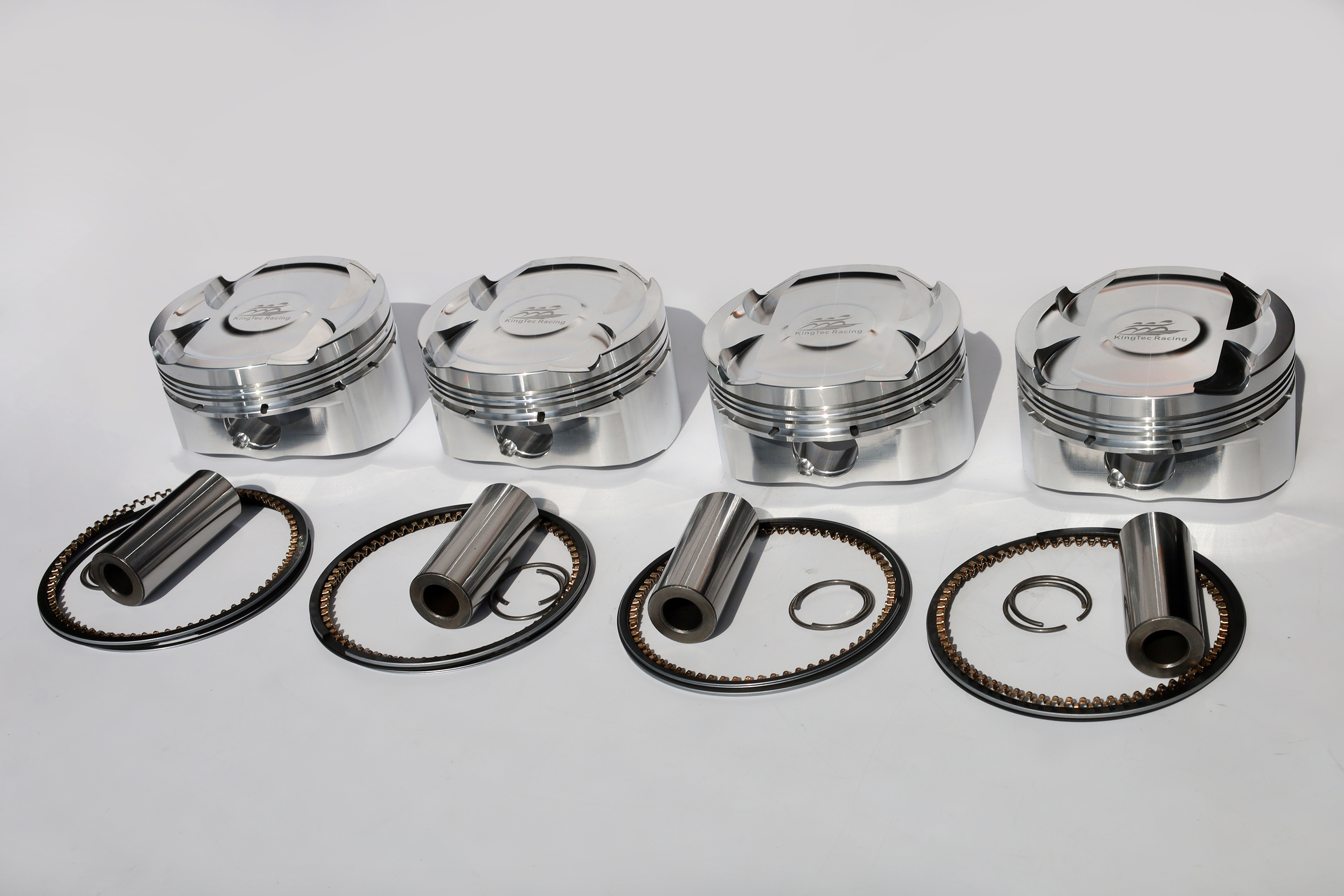
Bore Size Matters: Finding the Right Piston Clearance
Cylinder bore size plays a crucial role in determining the ideal piston-to-wall clearance, as it directly impacts thermal expansion, friction, and sealing efficiency.
Large-Bore Engines: Platforms like the Toyota 2GR and Subaru EJ25 generate intense heat and higher piston expansion under heavy loads or boost. If clearances are too tight, scuffing or seizure may occur. KingTec Racing’s forged pistons for these applications are precisely engineered with optimized thermal allowances, ensuring durability and consistent performance under extreme temperature and pressure conditions.
Small-Bore Engines: In contrast, smaller-bore engines such as the Toyota 1NZ and Honda L15A experience less thermal distortion, allowing for tighter clearances that improve compression, reduce blow-by, and enhance efficiency. KingTec Racing’s CNC-machined pistons maintain exact tolerances for both daily and track use.
By carefully matching piston diameter, bore geometry, and intended use, KingTec Racing ensures every engine—whether large-displacement or compact—achieves perfect balance between expansion control, reliability, and performance.
Engine Type: Naturally Aspirated vs Turbocharged
Different engine designs impose unique stresses on pistons, affecting the ideal piston-to-wall clearance.
Use Case: Street, Track, and Endurance Applications
How an engine is used dictates the optimal piston-to-wall clearance.

Consequences of Incorrect Clearance
Failing to achieve the right piston-to-wall clearance can have immediate and long-term consequences.
Too Tight:
When clearance is too small, the piston can’t expand freely as the engine warms up. This results in:
Too Loose:
If the clearance is excessive, the piston rocks in the bore, leading to:
Correctly calculated clearance minimizes friction, maintains compression, and reduces the likelihood of catastrophic failure. KingTec Racing uses real-world teardown data and testing to validate clearance recommendations, ensuring each piston performs reliably over the engine’s life cycle.
How Clearance Impacts Engine Longevity?
Proper piston-to-wall clearance is a foundational factor in engine performance and longevity.
KingTec Racing’s Precision Engineering Standards
At KingTec Racing, precision isn’t optional — it’s built into every stage of our piston manufacturing. Each forged piston is:
• CNC machined with micron-level accuracy to guarantee perfect dimensional consistency.
• Profiled with advanced expansion modeling, ensuring ideal geometry under real operating temperatures.
• Matched within ±1.5g weight tolerance across complete sets for smooth and balanced engine operation.
• Individually inspected for surface integrity, roundness, and clearance precision using state-of-the-art metrology equipment.
These engineering standards ensure every piston fits its bore with exact precision, maintaining consistent clearance and uniform combustion dynamics across all cylinders. Combined with our high-strength forged alloys and optimized heat treatment process, KingTec Racing forged pistons deliver exceptional reliability, reduced friction, and outstanding performance — even under the extreme conditions of high-RPM and forced-induction applications.
Choosing the correct piston-to-wall clearance isn’t just a technical adjustment — it’s the key to unlocking performance, reliability, and engine longevity. KingTec Racing forged pistons are crafted with high-strength alloys, advanced CNC machining, and application-specific tolerances to ensure perfect thermal balance and minimal friction under extreme conditions.
Ready to elevate your engine build?
Visit KingTecRacing.com to explore our full range of forged pistons, connecting rods, and crankshafts — engineered for precision, durability, and race-proven performance. Build smarter. Race stronger. Trust KingTec Racing!


